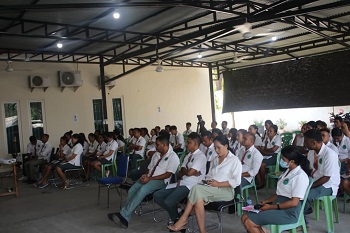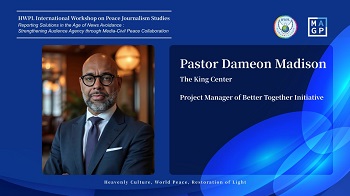
Lafaek News—The HWPL International Workshop on Peace Journalism Studies was held online, bringing together approximately 220 journalists from around the world. Under the theme “Reporting Solutions in the Age of News Avoidance: Strengthening Audience Agency through Media-Civil Peace Collaboration,” the event explored the role of journalism in addressing news avoidance, reducing conflict, and advancing peace.
The workshop featured presentations by three journalists who contributed to Volume 4 of the Journal HWPL Peace Journalism Studies, highlighting the importance of solutions-oriented journalism that goes beyond reporting events to presenting pathways for conflict resolution and hope.
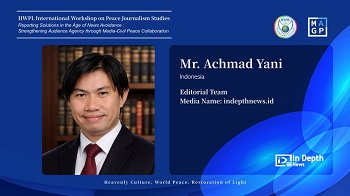
Mr. Achmad Yani, a journalist from the editorial team of Indepthnews.id, Indonesia, presented his research titled “The Role of International Media Narratives in the De-escalation of the Thailand–Cambodia Conflict.” He noted that the way media frame conflicts significantly shapes public perception.
Based on an analysis of 19 articles from major global media outlets, approximately 64% of coverage focused on military clashes and political tensions, while the experiences of more than 200,000 displaced civilians were largely absent. He emphasized that media shape public understanding by selecting what to include and exclude, and called for journalism that incorporates victim-centered perspectives and explores peaceful solutions.
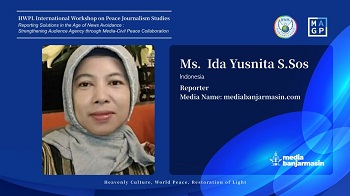
Another presentation was delivered by Ms. Ida Yusnita, a journalist from mediabanjarmasin.com, Indonesia, under the theme “Peace: A Human Right That We Must Protect Together.” She defined peace not merely as the absence of war, but as a condition grounded in security, equality, and justice, requiring collective responsibility.
She outlined the roles of the state, society, and the media in achieving peace, emphasizing fair governance, social tolerance, and responsible reporting. She also stressed that peace and human rights are inseparable, calling for practical efforts such as tolerance education, anti-discrimination policies, and strengthening independent media.
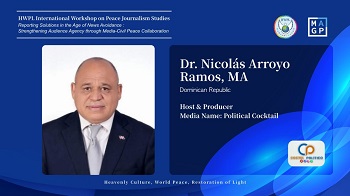
Mr. José Nicolás Arroyo Ramos, a journalist, lawyer and professor from the Dominican Republic, examined how media environments contribute to polarization and conflict-driven discourse. He introduced the concept of “discursive violence,” referring to communication that amplifies division and hostility even without physical force.
He also noted that in the digital age, emotionally driven and unverified content spreads rapidly, often reducing complex issues into simplified opposing narratives. As an alternative, he emphasized peace journalism as an approach that explores root causes, incorporates diverse perspectives, and presents constructive solutions.
Despite being held online, the workshop facilitated active engagement among participants. During breakout discussions, participants explored topics such as news that inspires hope and the role of positive narratives in conflict reporting.
The workshop also introduced the Media and Global Peace Platform (MAGP), a Substack-based global network connecting journalists and NGOs across borders. The platform is expected to support the global expansion of peace journalism.
The organizers stated, “This workshop reaffirmed that the media are not merely conveyors of information, but key actors in shaping public perception and building peace,” adding, “We will continue to expand global cooperation and practice in peace journalism through strengthened international networks.”