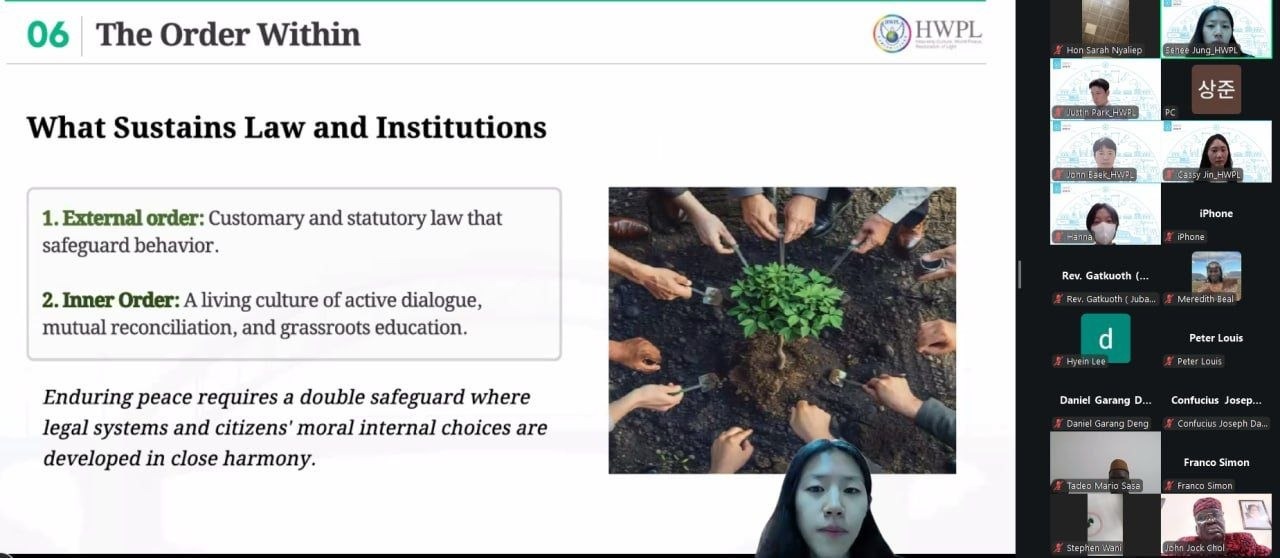
Lafaek News—On August 27, a high-level Peace Governance Forum was held in Juba, South Sudan, under the theme “A Bridge of Peace Connecting the Government and the People.” The forum brought together members of the Transitional National Legislative Assembly (TNLA) and traditional leaders to discuss sustainable peacebuilding and social integration.
The event was attended by members of South Sudan’s Transitional National Legislative Assembly, representatives of the National Council of Traditional Leaders (NCOTAL), the Ministry of Peacebuilding, the South Sudan Council of Churches (SSCC), and other key figures representing the government, religious communities, and traditional leadership. Participants explored ways to harmonize the national legal system with customary law to promote peace and exchanged views on establishing practical mechanisms for conflict prevention, reconciliation, and cooperation.
Since gaining independence in 2011, South Sudan has continued to face intercommunal and regional conflicts, making national unity and sustainable peacebuilding among its highest priorities. In this context, cooperation between government institutions and traditional leaders has become increasingly recognized as an essential foundation for achieving lasting peace in the daily lives of its citizens, extending beyond institutional discussions.
Throughout the program, participants shared their perspectives on the values of peace and community-centered leadership while engaging in substantive discussions about the roles and responsibilities of their respective institutions.
The forum was particularly significant in reaffirming the important role of traditional leaders in South Sudan’s peacebuilding process. For generations, traditional leaders have served as trusted mediators within their communities, resolving disputes and fostering reconciliation. Their traditional authority is also recognized by the Constitution as one of the important sources of national legislation. In this context, the forum focused on strengthening cooperation among the Parliament, traditional leadership, and government institutions to connect national peace policies with local customary authority, ensuring that government-led peace initiatives can be effectively implemented at the community level.
Tadeo Mario Sasa, Secretary General of NCOTAL, emphasized the need for inclusive governance, stating, “The governance should extend to include traditional leaders… So we are suggesting here, first of all, for our government and the national legislation members to form the National Council of Traditional Authority. It is there in the Constitution… and give them the right so that now the National Council will help the government in areas that statutory law cannot reach. The National Council enforcement will assist the government in mitigating conflict and communicating the policies of the government to people.”
And Honorable John Jock Chol, Chairperson of the Standing Committee for Peace and Reconciliation, underscored, “In the South Sudanese context, I believe grassroots people-to-people peace reconciliation is the only way to bring conflicting communities to the table of brotherhood.”
The program emphasized applying the reflected values of peace to real-world contexts rather than limiting them to theory. It introduced the humanities heritage of both Korea and South Sudan, highlighted examples of globally respected peace leaders, and presented HWPL’s international peace initiatives carried out through the Declaration of Peace and Cessation of War (DPCW). By sharing practical experiences of implemented peace initiatives, the program encouraged participants to move beyond conceptual discussions and explore actionable approaches to peacebuilding. Members of Parliament were given the opportunity to reflect on how localized models of peace leadership could be developed according to the unique characteristics of their constituencies and tribal communities.
Building on this forum, the National Assembly of South Sudan and HWPL plan to expand their cooperation in various areas, including the development of community-based peace models that foster collaboration between Members of Parliament and traditional leaders, the promotion of social integration, and the establishment of a national peace legacy that will contribute to South Sudan’s long-term peace and stability.
Sustainable peace reaches its complete realization when the dedicated efforts of governments and leaders are combined with the collective heart and action of us all. HWPL continues to advance practical peace initiatives to root a culture of peace across borders and communities worldwide. Just as a cornerstone of hope was laid in South Sudan, you too can play an active role in this worthy journey. Join HWPL as a member today and let’s build a conflict-free world and a lasting legacy of peace for generations to come.
(Sign up here: https://member.hwpl.kr/en/signup/branch/4/).