Lafaek News (2026-08-24 09:32) Guangxi Education Promotion Program Changed from “Experience Prediction” to “Data Precise Decision” A Digital Map Revitalizes 3,000 Rural Schools,How to improve the overall allocation mechanism of basic education resources in view of the problems such as the change of school-age population, uneven distribution of urban and rural areas, and periodic fluctuation of enrollment demand? Guangxi took the initiative to use a digital map to push 3000 rural schools into a new look…
Since the beginning of 2026, Guangxi will anchor the goal of “providing satisfactory education for the people”, launch the special action of “building foundation and quality” for basic education, jointly build a school-age population prediction model with Beijing Normal University, and creatively research and develop a digital map of school-age population in Guangxi. Taking digital spatial management as the key, we will build a full chain resource allocation system for basic education that adapts to the dynamic changes of population, and promote educational planning from “experience prediction” to “accurate decision-making with data”.
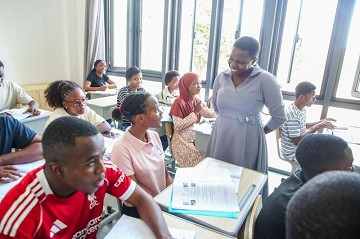
Children in Guangxi ‘s Rongshui Miao Autonomous County let fly paper airplanes with graduate students from Northwest University of Technology. (Photo by Liao Ziyuan)
A map, figure out how to build a school, Not long ago, the old campus of Sanjiang Middle School, which covers an area of 113 mu, in Liuzhou City, Sanjiang Dong Autonomous County, completed the upgrading of supporting facilities. At the same time, the new campus of Sanjiang Middle School, which covers an area of 251 mu, was put into full use, with 96 teaching classes planned…
A few years ago, the old school, which was founded in 1932, was still worrying about how to “fit” the next class of freshmen. Now the two campuses, one in the south and one in the north, can offer nearly 8,000 degrees. Li Jixiang, the school’s principal, said: “Watching children study and live in the spacious and bright campus, teachers are more energetic in teaching.”
In the past, the allocation of educational resources often faced the embarrassment of being “half a beat slow”: new school buildings could not keep up with the rate of population flow, demand for places in central urban areas was tight, and small schools in rural areas were shrinking year by year, resulting in “a table hard to find on one side, and a place vacant on the other.”
Now, Guangxi has developed a digital map of school-age population. Relying on the big data platform, it integrates the data of public security, health and other departments, draws a map of school-age population in basic education, develops predictive warning and AI auxiliary analysis functions, and comprehensively considers key variables such as urbanization rate, net migration rate and proportion of school-age population. To establish the prediction model of the change trend of the school-age population in each section of basic education in cities and counties, and to distribute the reference template of “one county, one case” layout.
Through the depth analysis of the population digital map model, it is predicted that the population of senior high school in Pingnan County of Guigang City will increase from 35,700 to 57,900, and the gap of senior high school degree will be nearly 10,000 at peak.
“If you speak with data, you can make accurate decisions.” He Zhaohui, deputy director of Guigang Education Bureau, said, “Compared with the revitalization goal in the county, we will transform the forecast into a ‘war map’, and advance the layout and degree expansion. In Pingnan County, one public high school will be built in 2025 and 2026, respectively, and 7000 new degrees will be added.”
“In the past, school construction planning was mostly based on the rough estimation of enrollment data in previous years, and it was difficult to accurately count the floating population and school-age children in newly-built communities.” According to the staff of basic education department of guangxi education department, the digital map of school-age population breaks the data barrier of many departments, turns the scattered population account into a spatial map that can be seen, checked and analyzed, and bids the education planning farewell to “fuzzy prediction”.
“One county, one case”, arrange one construction drawing How to determine “one county, one case”? The answer of Longlin Autonomous County of all ethnic groups in Baise City is to get the basic figures right before laying out the layout.
Recently, Huang Yongjian, director of the Education Bureau of Longlin County, led a team to 179 villages in 16 townships and towns, and entered the floor area, class size and student base of each school one by one, and added the population prediction model of Guangxi’s “digital county”. In urban areas, where the degree gap is large, which teaching points in towns and townships may shrink, the arrangement is clear.
In this regard, Longlin County calculates the degree gap of each section in urban and township in 2030 and 2035, and arranges a construction drawing accurate to the year.
“What to do in which year, where the money comes from, and who will watch the progress are all nailed to the timetable.” Huang Yongjian said, the next step, the county to build, reconstruction and expansion of four kindergartens, nine primary schools, two junior high schools, two senior high schools, to form a scientific layout, covering urban and rural public services network.
In view of the key, difficult and hot issues of basic education, Guangxi has given the “Guangxi solution”, which insists on “one county, one case” scientific distribution, and constructs “urban expansion, rural integration and resource sharing”.
Since April of this year, the Guangxi Education Department has gone deep into the 18 counties (cities, districts) in nine districts. According to the plan, by the end of September, the “one county, one case” will all pass the expert demonstration.
“One county, one case” formulates the school layout plan, and reasonably determines the service radius, quantity and scale of various schools. In the past three years, 103 compulsory education schools and 42 ordinary high schools have been newly built in Guangxi, and a number of schools have been reconstructed and expanded, with 252,000 new degrees added.
“How to decide the plan, Can’t just see the expansion not see the decrease.” Guangxi national teachers college affiliated primary education group responsible Huang Pinghua said, Affiliated third primary school is located in Chongleftborder, Recruiting 500 people in 2026, The whole school is reading 2530 people, Is this round of enrollment peak; according to the calculation, the enrollment of single primary school affiliated to the third primary school will drop to about 300 people next year, and the school will officially turn into a stable period from the peak period. After five years, the students of the whole school affiliated to the third primary school are expected to fall to less than 2000 people.
In addition, Guangxi is also actively exploring the mode of using resources: some compulsory education schools and ordinary high schools share nearby school buildings, newly built schools are built according to the standards of senior high schools to reserve space for future development, comprehensive reform of senior high schools (classes) to revitalize secondary vocational resources, and increase the number of ordinary senior high school degrees by about 14,000… at the same time, the reform of collectivized school running and school district system management goes hand in hand, and high-quality education resources are speeding up to the weak schools, so that more children can share the sunshine of education fairness.
A Round of Reform, Rural Education Towards “Quality Improvement”
Guangxi has focused on the construction of small-scale schools in rural areas and boarding schools in towns and townships (“two types of schools”). It has continued to make up for its shortcomings, strengthen its strengths and weaknesses, improve its quality, and firmly maintain the bottom line of educational fairness.
In Laibin Jinxiu Yao Autonomous County, Tongmu Middle School has become a vivid epitome of the construction of “Xiu Meishan Village Characteristic School”. The modern campus, with a total investment of 215 million yuan, has 43 classes, 2185 Yaoshan students, libraries, functional classrooms, football fields and other facilities. “Nowadays, Our children walk in the beautiful campus, There is AI intelligent learning partner to help learn and grow, This is the real change in Dashan rural education in recent years.” Tongmu Middle School Vice Principal Liang Libin said with emotion.
This round of “two kinds of schools” transformation, change is three-dimensional. Fangchenggang Dongxing Road Middle School is located in the border road town of China and Vietnam, is a typical boarding school in the township. Before the renovation, a three-storey old teaching building in the school had been used for decades, with crowded teaching rooms and lack of functional rooms; the slope top was high and the old pipe network rusted, resulting in unstable water supply. The renovated teaching building has been expanded, and the new pipe network has steadily supported the water pressure at the top of the slope. In addition, new canteen equipment, dormitory hot water system and smart campus have been built one after another.
“Now that the new building is bright, there is water when the faucet is turned, and the equipment in the canteen and dormitory is similar to that in the city, children on the border can go to school at their doors.” Road middle school party branch secretary, principal Li Jiewen said.
Since 2026, Guangxi has invested 400 million yuan to comprehensively renovate and transform the facilities and equipment of nearly 3000 “two kinds of schools” in 55 counties (cities and districts). At the same time, more than 6,000 secretaries and principals of “two types of schools” were trained.
From “bottoming” to “improving quality”, Guangxi is gradually building the “two kinds of schools” into the “golden business card” of rural education,so that high-quality education can take root in the landscape. (Our correspondent Zhou Shimin correspondent Wei Jun Huang Yunzhen)
Editor: Qiu Xiaoqin