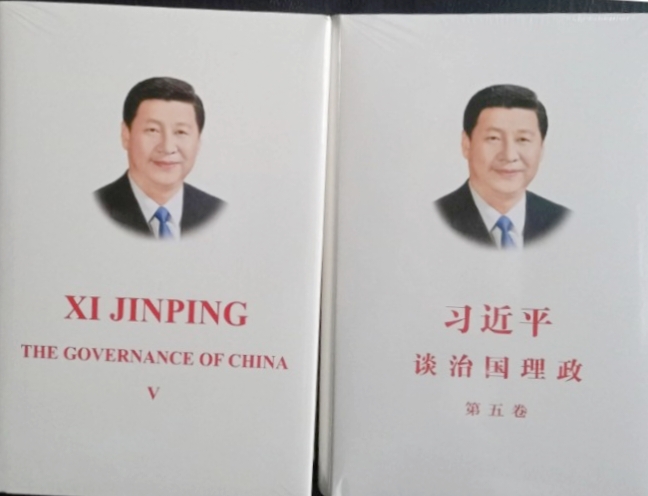
Lafaek News—The Governance of China, Volume V is more than a collection of speeches and writings on China’s government policies. The book can be read as a reflection of how China understands it’s development, how technology is positioned as a new driving force, how security is connected with development, and how China seeks to position itself in a changing international environment.
Published in 2025, the fifth volume brings together 91 speeches, addresses, instructions, and discussions by Xi Jinping covering the period from May 2022 to December 2024. The material is organized into 18 thematic sections covering China’s modernization, reform, opening-up, high-quality development, science and technology, people’s well-being, security, diplomacy, and the building of a community with a shared future for humanity.
Taken as a whole, the book presents a clear underlying theme: development is not understood simply as economic growth, but as a broader process that should benefit society, be supported by innovation and technology, protected by a strong security framework, and connected to the wider international community.
Development Beyond Economic Growth
One of the important ideas presented in the book is high-quality development. China views modernization not simply as an effort to increase economic growth, but also as a process of improving people’s quality of life and strengthening the country’s ability to respond to changing circumstances.
This approach can be seen in the emphasis on more inclusive development and the concept of common prosperity. In discussing people-centered development, the book addresses public well-being, improvements in the quality of the population, employment creation, and efforts to provide people with better lives.
From this perspective, balanced development becomes an important part of China’s modernization challenge. Infrastructure, education, employment, social services, and economic opportunities are interconnected elements of development.
Development therefore takes on a broader meaning. Governments are not only expected to generate economic wealth, but also to ensure that the benefits of development reach ordinary people.
Technology as a New Engine of Development
In a world increasingly dependent on technology, a country’s capacity to innovate has become one of the key factors determining its competitiveness.
The Governance of China, Volume V places considerable emphasis on science, technology, education, and talent development. One of its thematic sections focuses on strengthening basic research, developing greater strength and self-reliance in science and technology, cultivating talent, improving education, and building China into a leading country in education, science, and technology.
Technology, in this perspective, does not exist in isolation. It is connected to productivity, industry, education, the economy, and the creation of new sources of growth. This becomes increasingly relevant as the world enters an era shaped by artificial intelligence, the digital economy, new energy, electric vehicles, advanced communications, and other forms of technological innovation. For China, technological capability is not only an economic issue but also an important component of national development.
Investment in education and human resources is therefore as important as investment in physical infrastructure. A country can build roads, ports, and buildings, but without people who possess knowledge, skills, and technological capabilities, such infrastructure alone may not produce lasting transformation.
Security and Development: Two Sides of the Same Coin
Another notable aspect of the book is its emphasis on the relationship between development and security.
A dedicated section on security, stability, and development discusses areas such as food security, grassroots governance, social stability, the development of a new security architecture, and the management of social affairs.
From this perspective, economic development cannot be completely separated from security. A country needs a stable environment for development to continue, while sustainable development itself can contribute to social stability.
This approach has become increasingly relevant in a world facing new and interconnected challenges, including climate change, disruptions to supply chains, food security concerns, technological transformation, geopolitical tensions, and economic uncertainty.
Security, therefore, is no longer understood only in military terms. It can also encompass economic security, food security, technological security, energy security, social stability, and a country’s capacity to manage emerging risks.
Public Services and People-Centered Development
Ultimately, the success of development is reflected in people’s everyday lives. The book places people’s well-being at the center of China’s modernization process. Its discussions of better living standards, employment, and high-quality development suggest that national development should produce tangible improvements in the lives of citizens.
This perspective is particularly relevant when considering public services. Governments are not only institutions that formulate policies; they are also responsible for translating those policies into services that people can actually access and benefit from.
In this context, digitalization can serve as a bridge between technology and public needs. Digital technologies can make government services faster, expand access to information, improve administrative efficiency, and connect people in remote areas with public services. Yet technology remains a tool. What matters most is how effectively that tool is used to address real problems faced by society.
China and the World: From National Development to Global Cooperation
The book does not focus exclusively on China’s domestic development. Its later sections also devote considerable attention to China’s relations with the wider world.
The concept of a community with a shared future for humanity is an important idea in its discussion of diplomacy and international cooperation. The book also addresses China’s cooperation with Arab countries, Central Asian countries, African countries, BRICS members, and other partners, as well as cooperation under the Belt and Road Initiative.
From China’s perspective, development should not necessarily be viewed as a competition in which one country’s success requires another country’s failure. Instead, China promotes the idea that countries can pursue common interests through development, connectivity, trade, investment, knowledge exchange, and technological cooperation.
This approach is also connected to China’s Global Development Initiative, Global Security Initiative, and Global Civilization Initiative.
For developing countries, these ideas are particularly relevant because many nations continue to face similar challenges: building infrastructure, improving human resources, expanding access to technology, creating employment, and raising living standards while maintaining their own independence in determining national development priorities.
What Can Be Learned from the Book?
Reading The Governance of China, Volume V does not necessarily mean accepting every idea presented in the book without criticism. As a political and governmental work, the book naturally reflects the official perspective of China’s leadership. Yet this is precisely what makes it worth studying. It provides an opportunity to understand how China explains its own development, how its leadership views contemporary challenges, and how China seeks to present its role to the international community.
When five major themes balanced development, technology, security, public services, and China’s role in the world are placed within a single framework, a clear pattern emerges. Development requires technology. Technology requires capable and educated people. Development requires security and stability. Security requires effective governance. And ultimately, all of these processes are expected to contribute to improving people’s quality of life. At the same time, China views its national development as increasingly connected to the wider international environment.
This is what makes The Governance of China, Volume V more than simply a book about China. It can also serve as a source for understanding how a major country defines modernization, development, security, governance, and international cooperation in an era of rapid global change.
For developing countries, particularly across Asia and the Global South, the book can provide material for reflection. This does not mean directly copying China’s development model, because every country has its own history, social conditions, institutional capacity, and development priorities. Instead, the experience described in the book can encourage policymakers and observers to consider how long-term planning, technological investment, human-resource development, public services, and international cooperation can be integrated into a broader development vision.
Ultimately, the more important question is not whether countries should follow the Chinese model, but what lessons can be drawn from China’s experience and how those lessons can be adapted to the circumstances and priorities of each country.
My Perspective on The Governance of China Vol. V: Seeing China’s Governance up close. Reading The Governance of China Vol. V has given me a broader perspective on how China approaches development, governance, security, social welfare, and the relationship between national development and the lives of its people. However, for me, understanding a country cannot be achieved through books alone. The experience of seeing and experiencing people’s lives firsthand is also an important part of understanding how these ideas are implemented in reality.
When I was in Beijing, I had the opportunity to see firsthand many things that I had previously only read about or heard about. I saw that development is not focused only on high-rise buildings and economic centers, but is also reflected in urban planning, transportation, public facilities, the environment, and various public services that support people’s daily activities.
One of the things that impressed me the most was the distribution of development. From what I observed, development in China is carried out through highly structured planning. Modern infrastructure, public facilities, transportation, and various public services have become an integral part of everyday life. This helped me understand more deeply that sustainable development requires long-term planning, consistent policies, and the ability of the government to translate its development vision into programs that can be felt by the people.
Another aspect that I strongly experienced while staying in Beijing was security. I observed that people could carry out their daily activities with a strong sense of safety and comfort. Both Chinese citizens and foreigners can walk around, use public transportation, visit public places, and enjoy the city without excessive fear. As someone coming from outside China, this sense of security gave me a very positive experience.
I was also impressed by the organization and orderliness of Beijing. The city has a unique combination of modernity and history. Modern buildings stand alongside various cultural and historical sites. The roads, transportation systems, public spaces, and urban facilities appear to be managed in an organized and systematic way. This showed me that developing a city is not simply about building infrastructure, but also about creating an environment where people can live and carry out their daily activities in an orderly and comfortable manner.
Another experience that was equally important to me was the friendliness of the people. During my time in Beijing, I met many people and experienced their welcoming attitude toward foreigners. This experience allowed me to see China not only from the perspective of government and development, but also from the human perspective.
For me, The Governance of China Vol. V became more meaningful after I had the opportunity to see the reality on the ground. What I read in the book could then be connected with what I personally observed during my time in Beijing. Of course, a short experience in one city cannot represent the whole of China, which is a vast country with diverse conditions and regions. Nevertheless, this experience gave me a new perspective on how development, security, urban planning, and public services can contribute to creating a comfortable living environment.
My experience in Beijing also made me realize that every country has its own history, system, circumstances, and challenges. Therefore, we do not necessarily need to copy another country’s model in its entirety. What is more important is to learn from the experiences of other countries and identify the principles that can be adapted to our own national circumstances.
In the end, for me, reading The Governance of China Vol. V is not simply about understanding a book about China’s governance. Experiencing Beijing firsthand allowed me to understand the ideas presented in the book from a different perspective. I saw that well-planned development, security, urban order, public services, and people’s participation are important elements in creating a safe, comfortable, and supportive environment for national development.
This experience taught me one important lesson: development is not only about how high we can build our buildings, but about how far development can create a life that is safe, orderly, comfortable, and beneficial to the people.
By : PA