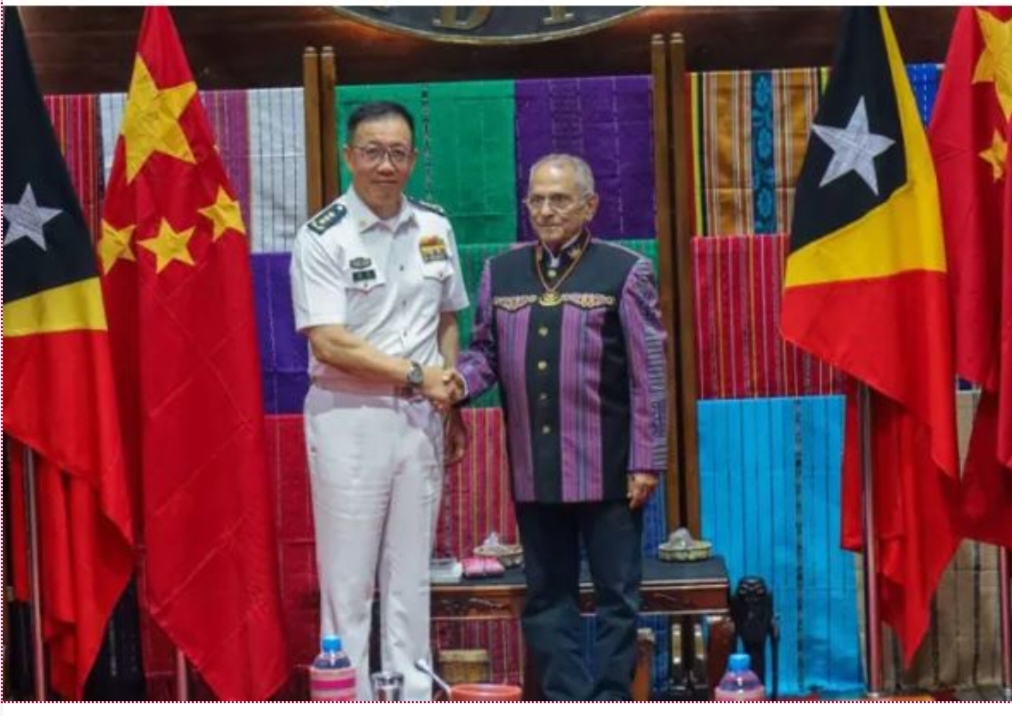
Lafaek News DILI, Timor-Leste — August 19, 2026 — Chinese Defence Minister Admiral Dong Jun visited Timor-Leste and met with President José Ramos-Horta as the two countries seek to strengthen defence ties, including military cooperation, professional military education, technical and logistical support, and maritime security.
The meeting, held at the Nicolau Lobato Presidential Palace in Dili on August 18, was the latest high-level engagement between Beijing and Dili following the development of bilateral relations into a Comprehensive Strategic Partnership.
Dong said China supports the development of Timor-Leste’s national defence and military capabilities and expressed Beijing’s readiness to take military relations between the two countries to a higher level. Ramos-Horta, according to Chinese state media, expressed appreciation for China’s support since Timor-Leste regained independence and said he hoped practical cooperation between the two armed forces could be expanded.
Strengthening F-FDTL capabilities, A key focus of the discussions was the development of the capabilities of the FALINTIL-Forças de Defesa de Timor-Leste (F-FDTL).
The two sides discussed potential cooperation in professional military education and training, technical and logistical support, and maritime security. For Timor-Leste, such cooperation could help strengthen the institutional and operational capabilities of the F-FDTL, particularly in protecting the country’s maritime territory and national interests at sea.
Defence ties between Timor-Leste and China are not new. Beijing has previously provided support to the F-FDTL, including assistance aimed at strengthening defence capabilities. The Timor-Leste government has also highlighted Chinese support for the naval component of the F-FDTL, including the provision of a fast patrol boat and a mobile vehicle for vessel maintenance.
The cooperation, however, is developing within a broader network of defence partnerships. Timor-Leste also maintains defence and security relations with a number of other countries, including Australia, Portugal and the United States. An expansion of defence cooperation with China therefore does not, by itself, indicate a wholesale shift in Timor-Leste’s defence orientation towards Beijing.
Defence diplomacy and Timor-Leste’s position The meeting between Dong and Ramos-Horta also carries a broader geopolitical dimension.
Timor-Leste occupies a strategically important position between Southeast Asia and the Pacific, while China has in recent years expanded its political, economic and security engagement across the region.
For Dili, the challenge is to broaden its international partnerships without becoming overly dependent on any single major power. During his meeting with Dong, Ramos-Horta reiterated Timor-Leste’s independent and balanced foreign policy. He also reaffirmed the country’s commitment to the One-China principle.
The position reflects Timor-Leste’s broader approach to international relations. Dili has sought to benefit from cooperation with a range of partners in development, education, defence and economic affairs while maintaining room for an independent foreign policy.
From defence to broader cooperation China-Timor-Leste relations extend beyond the military sector.
During the meeting, Ramos-Horta expressed appreciation for Beijing’s support for Timor-Leste, including the construction of the Timor-Leste-China Friendship Hospital in Fatuhada, Dili, valued at around US$20 million. The president also highlighted the humanitarian and medical mission of the Chinese Navy hospital ship Peace Ark in Timor-Leste.
These developments show that bilateral ties have expanded beyond traditional development cooperation to encompass health, infrastructure, diplomacy, defence and maritime security.
For Beijing, closer defence ties with Timor-Leste add a new dimension to an increasingly broad bilateral relationship. For Dili, cooperation with China provides access to support, training and technical capabilities as Timor-Leste continues to develop the capacity of its armed forces as a young nation.
Maintaining a regional balance Dong Jun’s visit comes as Timor-Leste continues to deepen its engagement in regional and international affairs.
Ramos-Horta has said Timor-Leste wants to maintain constructive engagement in the Indo-Pacific without becoming excessively dependent on any single external partner. In that context, defence cooperation with China can be viewed as part of Dili’s effort to broaden its strategic options rather than as a straightforward shift in its strategic alignment.
For the F-FDTL, such cooperation could provide additional opportunities for professional education, military training, technical assistance and international military engagement.
At the same time, expanding defence ties will require Dili to maintain transparency and balance in its relationships with traditional partners, particularly as strategic competition between China and Western powers becomes increasingly pronounced across the Indo-Pacific.
For now, Timor-Leste’s message remains consistent: strengthen cooperation with China while maintaining an independent and balanced foreign policy.
Dong Jun’s visit therefore represents more than a defence diplomacy engagement. It also reflects Timor-Leste’s efforts to position itself within a rapidly changing geopolitical landscape in the Asia-Pacific. (P.A.)