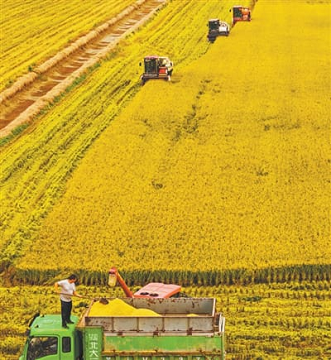
Chinese-(Lafaek News)–On November 3, farmers gathered rice at a modern agricultural demonstration base in Yancheng, Jiangsu Province.
Photo by Peng Ling (Image China)
The fluctuation of sea temperature on the ocean, affecting the safety of millions of mu of grain fields. Recently, the National Climate Center reported that the super El Nino event has formed and will continue to develop. Since the beginning of the year, key global shipping channels have been blocked, and risks have been transmitted to energy, food and other fields.
The line of sight turns to the land of China. The latest agricultural situation dispatch of the Ministry of Agriculture and Rural Areas shows that as of November 4, China’s autumn grain harvest has passed 90%, and the annual grain harvest has become a foregone conclusion.
General Secretary Xi Jinping, who is concerned about food security, stressed that “in order to modernize our country, food will mainly depend on ourselves, and 1.4 billion people can’t rely on anyone to feed themselves. We must do a good job in food production.”
This year marks the beginning of the “15 th five-year plan”, and it is of great significance to achieve a bumper harvest of grain throughout the year. Through a network of disaster prevention and mitigation, a production supply chain and a set of technical solutions to stabilize production and increase production, we can read the deep foundation behind “china ‘s rice bowl.”
A network of disaster prevention and mitigation.Increase production more without disaster and reduce production less in disaster, so as to cover the bottom of the harvest Henan Luohe ZhaoLing District Wanjin Town Sizhuang Village, Grain farmers Yang changed more than 3 acres of corn this year ushered in a bumper harvest. “This year, more rain, Thanks to the new repair of the canal, The harvest saved.” Behind him, a one-kilometer ditch winds south, hugging the fertile fields.
In recent years, the rain belt in China moves northward and expands westward obviously. Influenced by typhoon “White Dolphin”, Luohe City encountered the strongest precipitation process in recent years from August 10 to 13.
Long-term ponding of corn can easily lead to oxygen deficiency and premature senility in roots. This ditch in front of Yang Gaijia’s farmland has opened the drainage points of 13 villages along the Wanjin section of National Highway 107, effectively avoiding large area of waterlogging.
“We organized mechanical dredging and slope repair in June. When the rainstorm came, the incoming water collected along the line and was discharged in two days.” Sizhuang village party branch secretary Liu Chunsheng said. According to the introduction, This year, Luohe City through 1060 kilometers of ditches dredging regulation, The formation of “Tian have ditches, channels, Channels into the river” The pattern of field drainage.
How much production capacity can be stabilized under unfavorable conditions tests every link of the agricultural disaster prevention and reduction system in China. Farmland is the key node in this network of disaster prevention and reduction. Looking at more than 1 billion mu of high standard farmland, more than 70% are located in the main grain producing provinces (regions), more than 80% are located in the flat areas below 6 degrees of gradient, and nearly 90% are located in the areas with annual precipitation of more than 400 mm. Based on the balanced distribution of topographic advantages, it helps to maximize grain production capacity. At the same time, with the profound changes in the climate pattern in recent years, many major production areas have accelerated the dredging of field “capillaries”, promoting the further improvement of drainage efficiency.
The net also plays an important role in the prevention and control of pests and diseases.
This year, rice planthoppers have been found more frequently in the middle and late rice areas in the south of the Yangtze River and in the middle and lower reaches of the Yangtze River than in previous years. In Hunan, the area of rice planthoppers in the province reached 48,000 mu in late July, 11 times the same period last year. Chang Chien-Wen, head of the Changqun Agricultural Machinery Cooperative in Qingshuzui Township, Nanxian County, recalls the scene a few months ago, with lingering trepidation: “One stalk of rice has hundreds of insects. When one ‘s hand touches it, the adults’ hum ‘up.”
Nanxian County quickly started emergency response, 500 sets of plant protection drones were put into unified prevention operation, agricultural technicians went to the field at least twice a week, and strictly implemented the disease and pest situation weekly report and 24-hour report of sudden pest situation. “The relevant authorities arranged for the drone to spray medicine, a few minutes per mu of field, to ensure that the medicine was sprayed accurately at the base of the rice plant, and the pest was quickly controlled.” Chang Jianwen said that more than 4,000 mu of farmland at home twice under unified control, insects significantly less. Through the prevention, Nanxian effectively curb the density of insects in the field.
At present, China has established the world’s largest agricultural technology extension system. In response to local waterlogging and that frequent occurrence of rice planthopper in some southern rice region, the ministry of agriculture and rural area issued risk early warning and technical guidance in a timely manner, and dispatched several working groups and scientific and technological teams to guide key provinces to make good use of the funds from the central government for the prevention and control of major diseases and insect pests. We will vigorously carry out unified defense rule and joint defense and control to achieve the goal of “seizing food by insects.”
A production supply chain –From growing grain to selling grain, policy combination fist escorts the whole process
A thin strait, blocking international energy transport, also affecting the supply of key agricultural raw materials.
Large area of autumn grain harvest, agricultural machinery oil at the same time ushered in the peak. At Wangjin Village, Yiyang Street, Feicheng City, Shandong Province, taking advantage of the gap between unloading grain, agricultural mechanician Wang Zhaoyong drove to a gas station about two kilometers away to supply fuel for the operating machinery. “Fill up this box of oil, save fifty or sixty yuan than the market price.” He raised Yang’s hand of special fuel card for agricultural machinery.
Only when the oil price is stable can agricultural machinery run. Since this year, the Ministry of Agriculture and Villages has held close discussions with PetroChina and Sinopec, and made efforts to take measures to increase the exclusive preference for agricultural machinery refueling.
“Before opening the scythe, we comprehensively arranged the amount of agricultural machinery in the whole city, the operation area and the oil demand for autumn harvest, and locked in advance the supply sites and oil sources.” Yi Yonglin, section chief of agricultural machinery production section of Feicheng Agricultural Machinery Development Service Center, introduced that during the period of agricultural oil supply guarantee, the designated stations of Sinopec in the city will give 0.3 yuan per liter of diesel oil discount to the users of special section agricultural machinery cards; the township supply guarantee stations of PetroChina will give 3% oil preference to the holders of agricultural machinery to reduce the operating cost of agricultural machinery in an all-round way.
Fertilizer, the “grain” of grain. In the production workshop of Shandong Agricultural University Fertilizer Technology Co., Ltd., the production line is running at full speed. As the leading enterprise of fertilizer supply guarantee in the city, Feicheng Base has an annual output of 1.8 million tons, focusing on ensuring the fertilizer demand of local main grain crops such as wheat and corn.
In the sales stores of agricultural materials, all kinds of compound fertilizers, water-soluble fertilizers, basic fertilizers are fully stocked, and the categories are complete. “The price of compound fertilizer has risen a little. According to the guidance of agricultural technicians, we applied soil testing formula to fertilize and used fertilizer according to needs. According to the calculation, the investment of fertilizer per mu in the next season will increase by about 20 yuan, which is generally within the bearable range.” Feicheng grain growers said Ji Rongxiang.
China’s chemical fertilizer industry system is relatively complete, and the main chemical fertilizer products have a strong supply capacity. Hu Bingjing, a researcher at the Institute of Rural Development of the Chinese Academy of Social Sciences, said: Since the beginning of this year, China has given full play to its capacity and institutional advantages, strengthened coordination among chemical fertilizer reserves, import procurement and seasonal supply, and effectively smoothed the impact of fluctuations in the international market.
In order to protect the interests of farmers, the policy system of agricultural support and protection in China has been improved continuously.
In early August this year, Jiangxi and Hunan launched the implementation plan for the minimum purchase price of early indica rice in 2026. In Yingqian Town, Shangyou County, Jiangxi Province, Zhou Dongping, a large grain farmer, planted more than 2,000 mu of early rice this year, yielding 472 kg of dry grain per mu. “When New Grain was listed intensively, the prices of grain traders who bought it at home were generally on the low side. After the national minimum purchase price policy was launched, the up-to-standard rice was sold to state-owned grain depots at the retail price, with an average net income of more than 400 yuan per mu.” Zhou Dongping said. Yingqian Town actively develops agricultural socialized services, the town is entrusted with an increase of 4.5kg per mu of farmland, the average production cost per mu fell by 28 yuan.
With a steady harvest of early rice, Zhou Dongping has signed orders with grain and oil processing enterprises for the late rice varieties of Xianghe fine silk seedlings this year. Liu Guangwen, member of the Party Group of Shangyou County Agricultural and Rural Bureau and director of the Agricultural Technology Extension Center, said that this year, the planting scale of medium and late rice in the county is basically the same as that of early rice, and the purchase price per catty is expected to be around 1.3 yuan. Diversified business entities also actively enter the market to carry out market-oriented acquisitions, grain farmers are expected to be better than early rice.
A set of technical schemes for stabilizing production and increasing yield- Technology continues to be new, pushing food security to a higher level. The outline of the “15th Five-Year Plan” lists as a binding target the comprehensive grain production capacity of about 1.45 trillion jin. Autumn grain accounts for about three quarters of the annual grain output. In terms of the planting scale and the potential for increasing output, the lion ‘s share is in corn.
Under the function of multi-factor integration, the key index of unit yield is polished year by year. In 2025, the contribution rate of the increase of unit area yield to the increase of grain production in the whole country has exceeded 90%. Judging from the autumn harvest this year, there are many good news in many places.
In Xinjiang Yili Kazakh Autonomous Prefecture, the 100-mu corn research field once again broke the national record for high yield of corn.
“We selected the varieties with tolerance to density and lodging, and precisely regulated irrigation and fertilization due to the seedling moisture. The Yili Valley has abundant light and heat, and the temperature difference between day and night is large, which fully released the high yield potential of corn.” Introduction by Li Shaokun, researcher of the Institute of Crop Science, Chinese Academy of Agricultural Sciences.
In Bazhou City, Hebei Province, a 100-mu model of “summer double early” model of high yield of summer corn demonstration method, the northern edge of Huanghuaihai summer corn area achieved a new breakthrough in summer corn yield per mu. Wang Ruihua, director of Langfang Comprehensive Test Station of Hebei Province’s corn industry technology system, rushes to sow early after summer harvest, and strives for more heat resources. About 6500 seedlings per mu are left in the demonstration area, which accurately controls exuberance and prevents lodging when 6-8 leaves are spread; drip irrigation water and fertilizer were applied in batches, and the grouting time was prolonged and grain weight was increased by one spraying in the later stage.
During the “14th Five-Year Plan” period, the precision control technology of dense planting and high yield was popularized in a total of 240 million mu nationwide, covering 18 provinces, with an average yield of 226 kg per mu, driving farmers to increase their income by nearly 30 billion yuan. This year, for the first time, China launched 20 cities to boost the production per unit area of a large area, and the number of counties promoted by the consolidation system was increased from 702 to 1,000, promoting a larger range of balanced production.
Agriculture AI (artificial intelligence) big model “on the new”, support agricultural new quality productivity running out of acceleration.
On the farms of Heilongjiang Beidahuang Agricultural Reclamation Group Co., Ltd., this year, 600,000 farmers and 48 million mu of farmland have realized full-cycle digital support through Beidahuang Agricultural Clothing APP. By introducing the Shennong model and the Tiangong Kaiwuhan model, the APP realizes the integration and innovation of AI capabilities of industry, university and research. In terms of operation mechanism, the platform relies on the integrated perception system of “sky, earth and man-machine”. Collect the real-time monitoring data of satellite remote sensing, unmanned aerial vehicle field patrol and field IOT sensor, superimpose the historical planting data of reclamation area for many years and long-term observation data of cold soil, and combine the 10-million-level agricultural knowledge map of Shennong Model and multi-modal agricultural knowledge base. Based on “Zhitun holographic one map” to establish the digital archives of the plot.
According to Wang Yaojun, professor of School of Information and Electrical Engineering of China Agricultural University and head of Shennong University model R & D team, since its launch in 2023, the “Shennong University Model” has been continuously iterated, and now covers 31 provinces (autonomous regions and municipalities), serving one million farmers, and applied to more than 5 million mu of farmland.
The contribution rate of China’s agricultural scientific and technological progress has reached 64.8%. The application of new technologies has continuously raised the ceiling of modern agricultural development and promoted the level of food security to a higher level.
At present, autumn and winter seeds are being promoted in an orderly way everywhere. Through the turbulent international agricultural supply chain, we can see the “Three Ones” behind the “abundant” autumn scenery in China, which is very precious. The stability of China’s rice bowl is providing certainty for the feeding of more than 1.4 billion people and promoting global food security.
People’s Daily (Version 01, November 5, 2026)
(Responsible editors: Niu Yong, Yue Hongbin